Culture
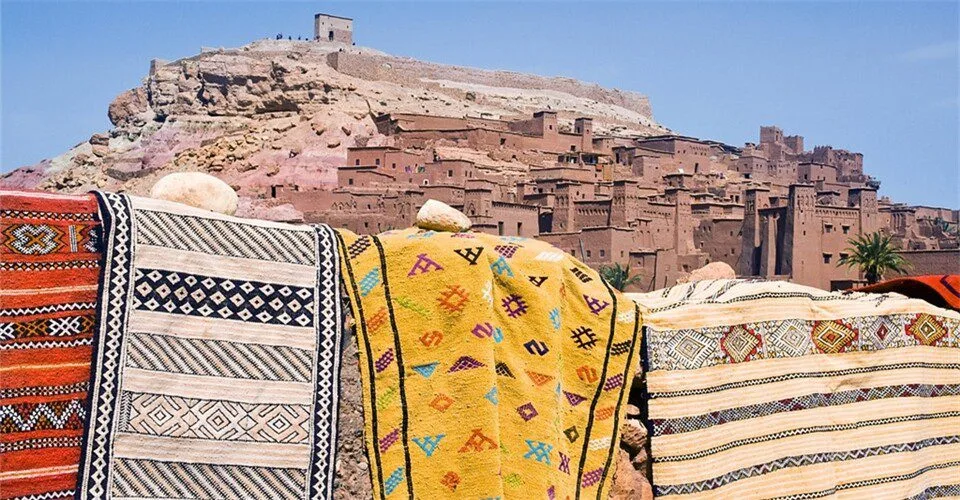
The production of rugs is one of the most important crafts in the country, primarily woven by rural women, Berbers from the mountains. The rug culture is deeply rooted in Morocco, along with its value, which does not fade with time, as it remains an essential element used to cover the floors of homes. Most
Tour Specialist & Advisor
Published on August 16, 2024 · Updated on July 27, 2026
Originally from China, Thea has explored Morocco extensively for over 10 years. She specializes in recommending hidden corners from North to South.
The production of rugs is one of the most important crafts in the country, primarily woven by rural women, Berbers from the mountains. The rug culture is deeply rooted in Morocco, along with its value, which does not fade with time, as it remains an essential element used to cover the floors of homes.
Most of them are made from lamb’s wool from animals less than a year old. The wool is hand-spun, knotted, and produced in small cooperatives and factories. They are also made from cotton, silk, and synthetic fibers.
There are woven rugs (kilims) on frames. These are more expensive because they require more time and raw material. The most sought-after are the ‘abrass’, with threads of the same color but in different shades. The most exceptional ones are those made without a pattern, with asymmetric designs.
The concern is that the tradition is being lost, as it is not profitable due to the high cost and use of wool (10 kg for a standard rug) and the time required to create them, about two months of work.
In the mountains
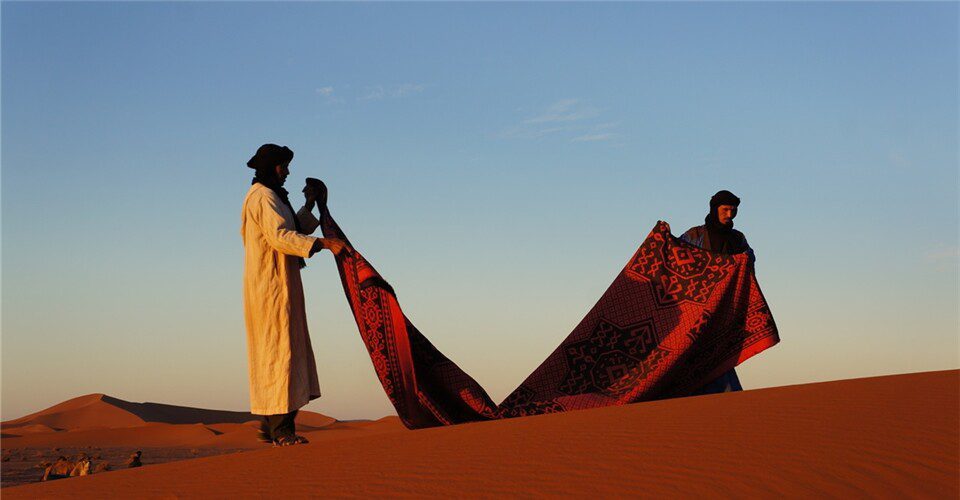
The Middle Atlas is famous for the weaving of the Zemmour, Beni Mguild, and Marmusha tribes. In the High Atlas, the population of Tazelnakth is concentrated. In the Sahara, rugs from the Alnif oasis stand out. From the plains of Haus (the Tensif valley region in Marrakech), to Chichaoua and, in the Rif, the Yebaka, Tetuan, and Chefchaouen cities are known for their rugs.
The rugs are made from coarse wool or silk, following a pattern characteristic of each region. They are extremely versatile: they can be hung on the wall to give the house an oriental feel, used to cover a bed, floor, or table, or used as a picnic blanket.
The design is generally geometric, limited only by the weaving technique, creating an impression of space and movement, but sometimes featuring details and fringes. The colors that mimic the landscape range from ochre to red.
One of the largest distribution centers is in the village of Tazenakht, High Atlas, near the Ouarzazate region. There is also an economical variety made from esparto or cactus wool, typical of arid areas.
Urban rugs
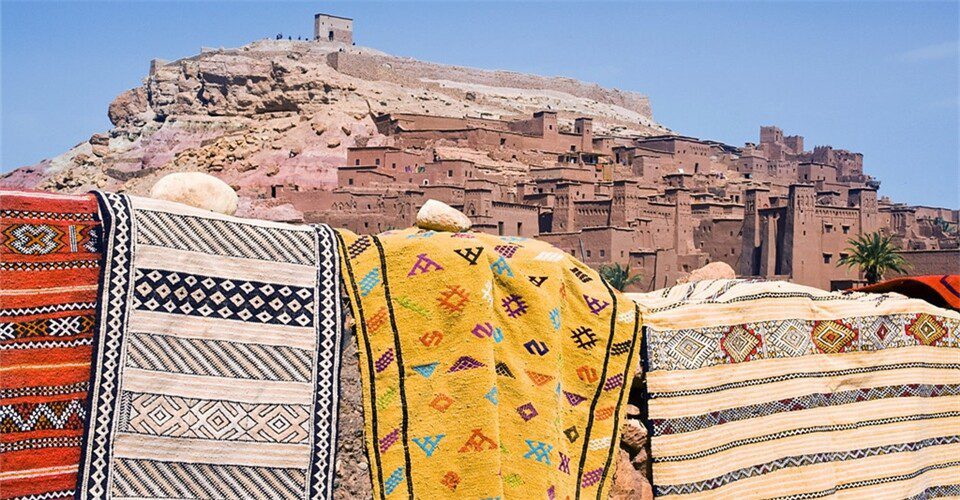
Urban rugs, more elaborate and expensive, are made in the large cities: Rabat, Casablanca, Mediouna, Tangier, etc. They have Turkish influence and are typically made of velvet, satin, or fine-textured fabric. These rugs are characterized by a central diamond or hexagonal medallion, called qubba, which stands out on a red background, surrounded by a wide frame of three to seven strips decorated with floral, geometric, or zoomorphic elements.
The traditional Moroccan wedding cloak, or handira, is a beautiful piece of fabric, handwoven with sheep wool and adorned with sequins. These blankets used in weddings are typical of the Zemmour region.
In recent years, rugs made from fabric scraps have become popular. These rag rugs, called Boucharuite in Morocco and Jarapas in Spain, do not follow a traditional stylistic pattern, and are attributed to the city of Boujad. Initially, they were not made for commercial purposes, but today they are produced in a very similar way throughout Morocco.
Buying rugs in Morocco
It is a decorative, handcrafted product, easy to transport, and available in a range of prices that suit all budgets. The finer ones are very practical, such as bedspreads, while the more expensive ones are of a quality comparable to the finest Turkish or Persian rugs.
There is an abundance of these rugs in all bazaars — they may sell low-quality products if we are not experts. We recommend comparing, visiting official stores, or purchasing a rug that has passed the quality control of the Ministry of Handicrafts, with a guarantee of origin and color code.
Visit Atlas villages and souks on our Nature and Culture tour or the 12-day Desert, Mountain, Sea, Oasis and Cities route. Browse all tours .
Contact us for more travel information!
Related Posts
The Moroccan Dances
The Kingdom of Morocco is a very colorful country. Its ancient history, unique culture and a special spirit that does not resemble anything attract tourists from all over the world. Moroccan national dances, which differ in great variety, can become an interesting topic. So let’s get acquainted with them of a North African country. What, where
Moroccan Costumes
Morocco is a country rich in history, traditions, peoples, culture, religion, climate, geography and more. Each of these aspects of the country influences the dress fashion of Moroccans. Among the wide variety of clothes in Morocco, we find many refined clothes that evoke the luxurious dress style of the country. Djellaba If you walk through the
Typical sweets from Morocco
Moroccan desserts compose an epic written with sugar and spices, dancing to a triple melody of Arabian roses, Mediterranean citrus, and Saharan dates. These sweet arts steeped in millennia of civilization carry both the wild breath of Berber nomads and the refined DNA of Andalusian courts. With marked influences from the Middle East, Africa and the area that